
 See My Latest Article on HelloNation
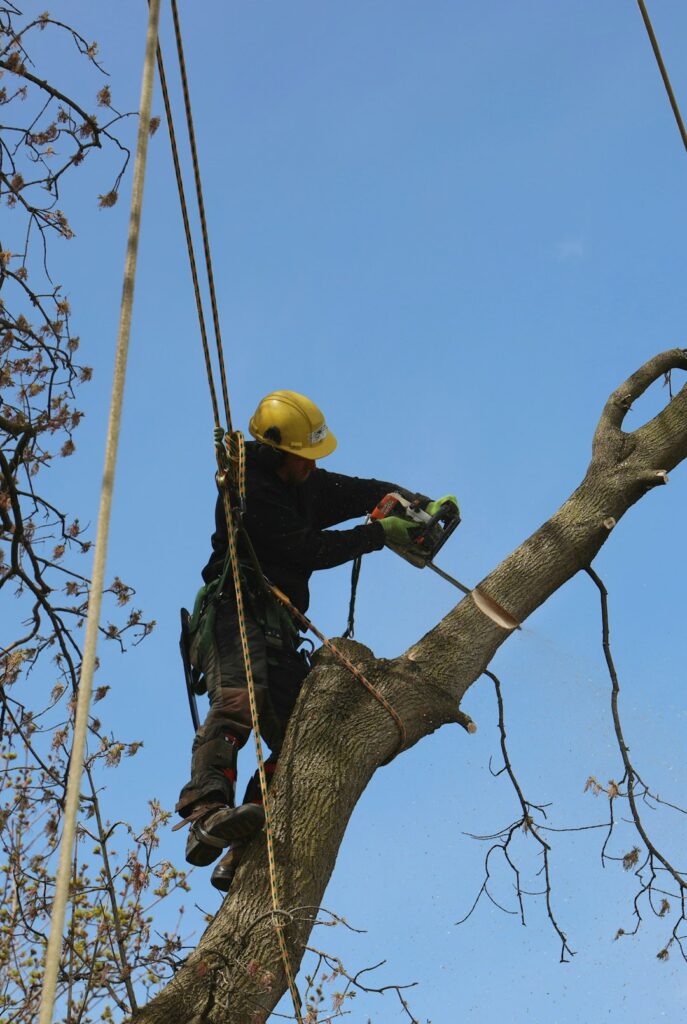
Tree topping is the practice of cutting major branches back to stubs or short side branches, usually to make a tree shorter or narrower. Although it may seem like a quick solution for trees near roofs, roads, or utility lines, topping often creates longer-term problems and is rarely considered sound structural pruning.
What does tree topping mean?
Tree topping removes large portions of a tree’s crown without following the tree’s natural branch structure. A topped tree may have several large limbs cut at the same height, leaving blunt stubs and an unnaturally flat or thin appearance.
Topping is different from careful crown reduction. Proper reduction cuts are made back to suitable lateral branches that can continue the growth pattern. Topping commonly removes branches too large for the remaining side shoots to support effectively.
The practice is sometimes described with terms such as “heading,” “rounding over,” or “butchering,” although not every use of those terms refers to exactly the same pruning method.
Why do property owners consider topping?
The perceived benefits are usually immediate and visual:
- The tree becomes shorter for a short period.
- Branches may be moved farther from a roof, driveway, or nearby structure.
- More sunlight may reach a yard, garden, or window.
- The work may appear less expensive than removing and replacing a poorly placed tree.
- A tree may look less threatening after large limbs are removed.
These results can make topping seem practical, especially after a tree has grown into a space that was too small for it. In a community with wooded lots, mature shade trees, and homes built near established vegetation, that situation is not unusual.
The difficulty is that topping treats the visible size of the tree without addressing its structure, species, health, or growing conditions.
What are the main disadvantages?
Topping can weaken a tree, increase future maintenance, and create new hazards. The problems often develop gradually, which makes the original work seem successful at first.
Rapid, weak regrowth
After losing much of its crown, a tree may respond by producing numerous upright shoots near each cut. These shoots grow quickly because the tree is trying to replace lost foliage.
They are usually attached less securely than naturally developed branches. As they become heavy, they can break during strong wind, wet snow, or ice loading. In Windham, seasonal storms and winter precipitation can place additional stress on these new shoots.
Larger decay-prone wounds
Large topping cuts expose much more wood than ordinary pruning cuts. The tree may seal the edges of the wound, but it cannot restore the original branch structure. Moisture, insects, and decay organisms may gain access to the interior.
A large wound does not automatically mean a tree will fail, but repeated large cuts can reduce the tree’s ability to compartmentalize damage and maintain strong growth.
Greater sun and temperature stress
A tree’s leaves and branches help shade its trunk and major limbs. Removing much of the canopy can expose previously shaded bark to intense sunlight and rapid temperature changes.
This may contribute to sunscald, bark injury, and stress during hot or dry periods. Trees already affected by root disturbance, compacted soil, drought, or construction damage may be less able to recover.
Loss of natural form
Topping changes the tree’s shape in a way that is difficult to correct. New shoots may grow unevenly, and the tree may develop a dense cluster of branches where one or two stronger limbs would have been preferable.
The result is often a tree that requires repeated pruning to maintain an acceptable appearance. Over time, the cost and frequency of maintenance may exceed the perceived savings from the original topping.
Reduced food production
Leaves manufacture energy through photosynthesis. Removing a large percentage of the crown reduces the tree’s ability to produce and store food.
A healthy tree may recover, but recovery is not guaranteed. Older trees, trees with disease, and trees growing in poor soil may decline after severe crown removal. Some may show reduced vigor, dieback, or increased susceptibility to pests.
Does topping make a tree safer?
Usually, no. Topping may remove heavy branches temporarily, but the weak shoots that follow can create new points of failure. A shorter tree is not necessarily a safer tree.
Safety depends on the tree’s species, trunk condition, root stability, branch unions, lean, defects, and surroundings. A tall, well-structured tree may be less hazardous than a shorter tree with decay and poorly attached regrowth.
A tree near a house, road, play area, or utility line deserves a careful risk assessment rather than automatic height reduction. Branches that are cracked, hanging, partially detached, or entangled with utility wires should not be handled casually.
Can topping solve a tree that is too large for its location?
Topping rarely provides a lasting solution. Most trees will continue growing, and the replacement shoots can quickly return the crown to its former height while creating a weaker structure.
Better options depend on the situation:

- Remove selected branches back to their natural points of origin.
- Reduce the length of individual limbs to suitable lateral branches.
- Remove dead, broken, rubbing, or poorly attached branches.
- Use formative pruning on younger trees before structural problems become severe.
- Consider removal and replacement when a mature tree is fundamentally unsuitable for the site.
Tree selection matters. A species that naturally reaches a large mature size may not be appropriate beneath utility lines, beside a narrow driveway, or close to a building. Planting a suitable tree in the right location is often more effective than repeatedly cutting back an unsuitable one.
Is topping ever appropriate?
There are limited situations in which severe reduction may be unavoidable, such as emergency storm response, specialized utility clearance, or certain restoration efforts. Even then, the work should follow a specific safety and structural objective rather than simply cutting the top flat.
Routine residential pruning should generally preserve the tree’s main leader, major limbs, and natural crown shape whenever possible. A tree that must be reduced substantially may instead need removal, replacement, or a more carefully planned multi-stage reduction.
Not every short tree has been topped. Some species naturally have rounded crowns, and some trees have been reduced carefully over time. The defining issue is whether large limbs were cut indiscriminately, leaving stubs or weak side branches.
What should Windham residents check before pruning?
Before major pruning, consider the tree’s surroundings and recent stress:
- Is the tree near a home, roadway, fence, or play area?
- Are there overhead utility lines?
- Are any limbs cracked, hanging, or recently damaged by wind or ice?
- Does the trunk show cavities, seams, mushrooms, or large dead sections?
- Has construction, paving, grading, or soil compaction affected the roots?
- Is the tree already showing sparse foliage or extensive dieback?
Routine pruning of small, reachable branches is different from climbing or cutting large limbs. Work involving ladders, chainsaws, suspended branches, utility lines, or storm-damaged trees can quickly become life-threatening. Maine guidance advises using a licensed arborist for hazardous tree work, especially where damaged limbs or electrical hazards are present.
For properties near regulated shoreland areas, additional vegetation rules may apply. Local requirements can depend on the property’s location and the type of work proposed, so major clearing or extensive pruning should be checked before work begins.
What is the practical alternative to topping?
The practical alternative is targeted pruning based on the tree’s structure and purpose. That may mean removing a few defective branches, reducing selected limbs to strong laterals, or leaving the tree alone if no meaningful hazard exists.
A good pruning decision asks what problem needs to be solved and whether cutting will address that problem without creating greater risk later. If the goal is to reduce shade, clear a roof, improve visibility, or manage storm exposure, the solution should be designed around the specific branches and site conditions—not simply the height of the tree.